
 By
By
Cloud spending keeps smashing records, yet many VARs still scrape by on razor-thin license margins. Fortunately, pairing the right partner program with the services you already deliver can boost profit, speed up deals, and improve customer retention.
In this guide, we compare the cloud channel’s most talked-about programs—distributor marketplaces, hyperscaler networks, and niche challengers—to reveal where the real money, support, and growth incentives hide. Treat it as your 2026 shortcut to smarter partnerships and stronger margins.
Our evaluation criteria for cloud partner programs
Choosing a partner program isn’t about chasing the biggest logo. We reviewed more than 40 guides, vendor decks, and candid partner threads to spot the five factors that decide whether you grow or stall in the next 12 months.
Profit comes first. We look past headline discounts to the full cash opportunity: stacked rebates, growth accelerators, market-development funds, and paid workshops that feed the bottom line. If a program traps you at a 3 percent license margin with no upside, it doesn’t make this list.
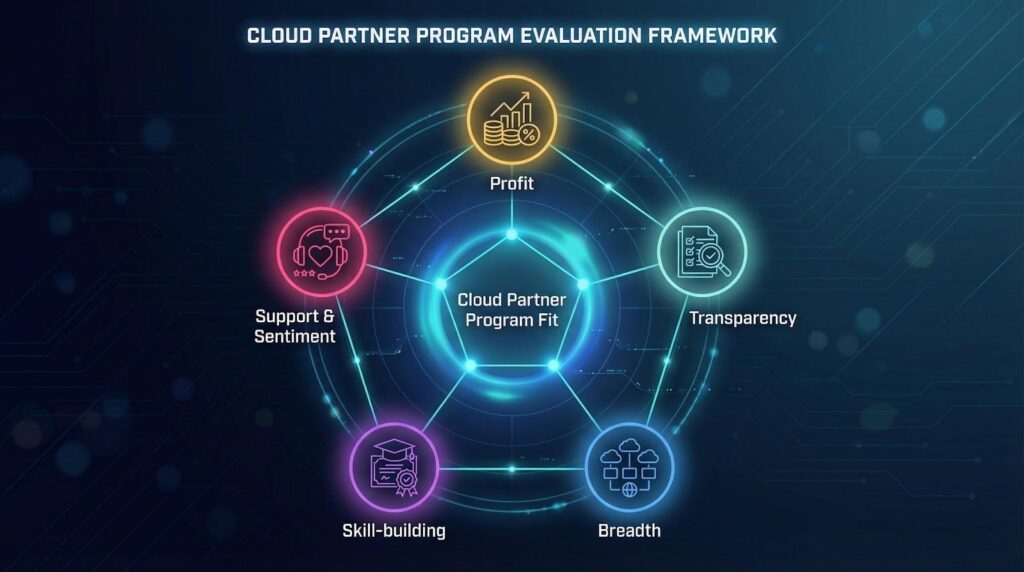
Transparency ranks second. Tier requirements, performance scorecards, and incentive formulas must be clear. When rules hide behind “contact your representative,” partners waste time guessing instead of selling.
Breadth holds the third seat. Multi-cloud buyers expect you to provision Microsoft seats today and spin up AWS tomorrow. Programs that cover several clouds (or integrate cleanly with others) score higher because they let you say yes more often.
Skill-building is our fourth pillar. We reward portals that automate billing, PSA syncs, and renewal alerts, plus free or subsidized certification paths. These perks cut overhead and sharpen the team without draining the training budget.
Fifth is support and sentiment. A hotline that rings forever or a ticket queue that stretches for days erodes trust. Programs known for quick, human help earn extra points and customer loyalty you can bank.
Hold every program to these five yardsticks, and the best partnerships become obvious.
Multi-cloud distributors and aggregators
Before we size up the hyperscalers, we need to highlight the partners that keep thousands of smaller VARs moving: two-tier distributors. These firms negotiate pricing with Microsoft, AWS, Google, and dozens of SaaS vendors, then wrap every SKU in one marketplace, one invoice, and, ideally, one responsive support desk.
If you’re launching a cloud practice or juggling a dozen vendor portals each month, this is the easy entry point. Distributors extend credit, manage billing, and pass along vendor rebates you can’t secure on your own. They also bundle training tools, migration utilities, financing, and marketing development funds that cut the time between quoting and cash collected.
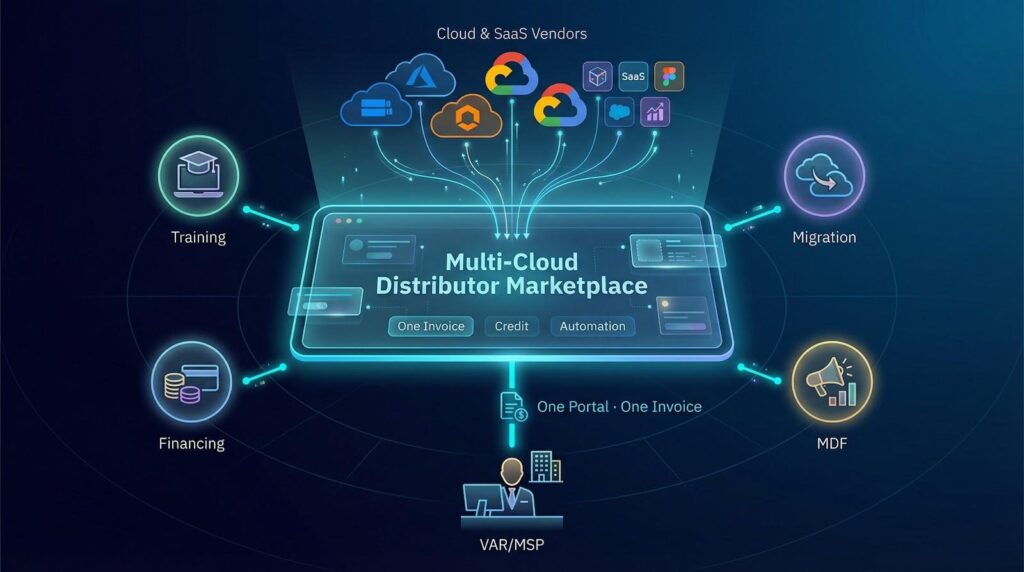
We focus on four platforms that dominate English-speaking markets and earn five-star marks in CRN’s Partner Program Guide. Each platform offers multi-cloud breadth, automation that removes manual billing, and human experts when the scripts fail. In the next sections, we’ll examine them one by one, noting where incentives rise highest and where partners still bump into red tape.
First up: the global heavyweight formed by the Tech Data and Synnex union.
TD SYNNEX Advanced Solutions Enablement
TD SYNNEX is the largest name in tech distribution, and that scale rewrites the math for cloud partners. When Tech Data and Synnex merged, they combined a logistics network spanning 100 countries with a multi-vendor cloud marketplace, giving VARs one contract that covers Microsoft, AWS, Google, and a long list of SaaS titles.
The biggest advantage is bargaining power. Because TD SYNNEX moves billions in hardware and software each quarter, vendors compete with extra rebate pools, bundle promotions, and extended credit terms. You gain those perks on day one, even if your firm has only five employees.
Their PartnerLink community adds real people and a clear process. Dedicated solution architects guide hybrid designs, while practice-builder workshops help you launch security or AI offerings without hiring a full bench. The recent “AI Game Plan” series sits inside a broader catalog of technology partner resources—ranging from assessment dashboards to white-label collateral—so partners can grab a template, run the workshop, and invoice services long before the first cloud bill arrives.
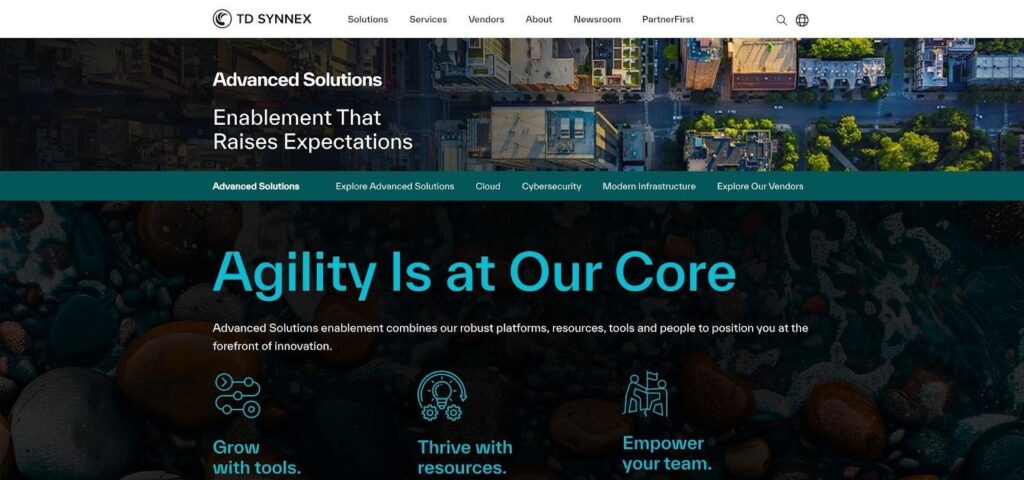
TD SYNNEX Advanced Solutions Enablement and Partner Resources Screenshot.
Operationally, the StreamOne platform (a union of the former Tech Data and Synnex marketplaces) automates provisioning across major clouds. You can quote Azure, spin up AWS reserved instances, and schedule Google Workspace renewals from the same dashboard, then roll everything into branded invoices. Fewer portals, fewer missed renewals, and no end-of-month spreadsheet scramble.
What about margin? Base discounts stay modest, roughly mid-single digits on Microsoft seats, but TD SYNNEX unlocks backend dollars others miss: vendor growth accelerators, stackable promo rebates, and campaign MDF. Partners who lean into these incentives often add 10 percentage points of effective profit on top of the raw resale spread.
The catch is sheer size. Newcomers can feel lost until revenue ramps high enough for a named rep. The fix is simple: engage early. Book onboarding calls, register deals, and attend the virtual bootcamps. Activity moves you up the queue and ensures a real person answers when an Azure migration stalls.
Verdict: If you juggle multiple clouds or want the buying power of a Fortune 100 without the balance-sheet risk, TD SYNNEX sets the bar. Treat the portal as your commerce hub and the support teams as an extension of staff, and you’ll convert scale into a steady, defendable margin.
Ingram Micro Cloud
If TD SYNNEX offers reach, Ingram Micro delivers raw catalog depth. Its CloudBlue marketplace manages more than 50 million SaaS and IaaS seats, and that range becomes clear the first time you build a bundle: Microsoft 365, AWS reserved instances, Cisco Webex, and niche vertical apps appear in one quote.
The technical edge comes from Xvantage, an AI-driven portal that suggests complementary services, flags renewals, and drafts proposals while you sip coffee. Partners report that this automation trims hours of billing work each month, freeing time for revenue-generating projects.
Discounts start small, roughly 3 to 8 percent on mainstream licenses, but Ingram sweetens the pot with stacked volume rebates. Cross the next revenue band and your back-end payout climbs without another sales call. Larger VARs also access proposal-based MDF that funds joint campaigns with the distributor.
Support scales with spend. Enterprise partners keep named reps and solution architects on speed dial, while newcomers route requests through a shared desk that can feel slow during quarter-end crunch. The antidote is participation: attend Cloud Summit, enroll in the free certification tracks, and escalate wins. Active partners gain visibility and faster responses.
Bottom line: pick Ingram when catalog depth and automation matter more than white-glove service. Climb the tiers, use the AI portal, and watch the margin curve tilt in your favor.
Pax8
Pax8 built its brand on one promise: make cloud reselling feel as easy as ordering pizza. Everything, from license provisioning to PSA sync, lives behind a modern interface that even the greenest technician can navigate in minutes.
The company favors quality over quantity. More than 100 vendors sit in the marketplace, each vetted for MSP-friendly billing and support. That curation keeps complexity low and margins healthy: partners report a 12 percent starting discount on Microsoft 365 that grows to 18 percent as seat counts rise. Add periodic SPIFFs and training vouchers, and effective profit soon beats most direct-to-vendor deals.
Service is the hook. Pax8 assigns a channel account manager at onboarding, routes calls to engineers who can solve issues, and hosts a community Slack where peers swap fixes in real time. Reddit’s r/msp threads read like fan mail, praising response times and a “they’ve-got-your-back” culture rare in distribution.
Training receives the same focus. Pax8 Academy offers free Microsoft, security, and sales courses; partners who finish tracks report an average 15 percent lift in valuation, according to internal data. Opportunity Explorer scans usage patterns and nudges you toward cross-sell plays you might miss. Less hunting, more selling.
There are caveats. Pax8’s narrow catalog means you may still need a secondary distributor for legacy licenses or unusual hardware. Credit-card processing fees introduced in 2024 annoyed some partners, yet most stay because the time saved, and the growth coaching provided, outweigh the occasional fee.
Bottom line: choose Pax8 when you prize speed, support, and a community vibe over carrying every product under the sun. For SMB-focused MSPs, it is often the fastest path from quote to recurring revenue.
Sherweb
Sherweb takes a different tack from the big-box distributors. Instead of chasing every vendor contract, it doubles down on Microsoft and a focused set of SaaS and security tools. That concentration pays off when you hit a licensing snag late on a Friday; Sherweb engineers know Microsoft quirks cold and often jump in to fix the tenant while you stay on the client call.
Partners praise responsiveness. Where larger distributors funnel new accounts through generic queues, Sherweb assigns a success manager who sticks around long after onboarding. Need help sorting Microsoft’s New Commerce pricing? The team will pull usage reports, map SKUs, and join your customer meeting to explain changes in plain language.
The portal once trailed Pax8 in usability, but a 2025 self-service upgrade closed most gaps. You can adjust subscription counts, spin up Azure resources, and trigger migrations without opening a ticket. If you would rather outsource the work, Sherweb’s no-cost migration desk exports mailboxes, cuts over DNS, and documents the project for your records.
Financially, discounts mirror Pax8 at roughly 10–15 percent on core Microsoft seats. Sherweb adds promo credits for Azure growth and bundles security software around M365 at a higher blended margin. Seasoned partners also tap a modest MDF pool for co-branded webinars and local lunch-and-learns.
Limitations remain. The catalog is narrow, and coverage outside North America is limited, so you may still rely on a broadline distributor for niche workloads or APAC clients. For VARs whose revenue centers on Microsoft cloud, Sherweb’s hands-on model turns complexity into a competitive edge.
Direct hyperscaler programs
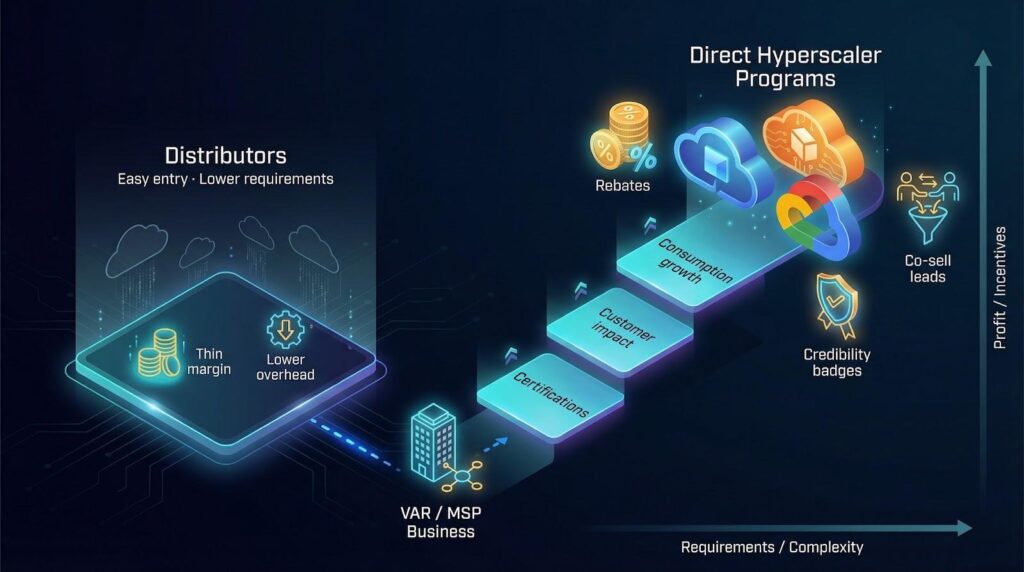
Distributor marketplaces carry the load when you are small, but many VARs eventually want a direct line to the clouds that drive the modern stack. A hyperscaler agreement opens richer rebates, co-sell leads, and the credibility that comes from displaying a Solutions Partner or Advanced badge on your deck.
The catch is commitment. Vendors ask for certifications, proof of customer impact, and steady consumption growth. Meet those targets, and the financial upside can eclipse indirect margins. In the next sections, we break down the big three: Microsoft, AWS, and Google, starting with the software giant that most of your customers already pay each month.
Microsoft AI Cloud Partner Program
Microsoft’s partner ecosystem dwarfs every other vendor’s, bringing both opportunity and complexity. In 2022, the company retired the Gold and Silver tiers and introduced Solutions Partner designations tied to six solution areas. Earning one opens a bundle of benefits: internal-use licenses, Azure credits, and a rebate system that can add double-digit points to thin license margins.
Cash surprises many newcomers. A basic indirect reseller might keep a five percent spread on Microsoft 365 seats, but when you add Partner Earned Credit on Azure, usage-growth rebates on Dynamics, and paid customer workshops, effective returns often rise above 15 percent on well-managed accounts.
Progression is clear but demanding. Certifications carry heavy weight; four intermediate exams can spell the difference between “member” status and full Solutions Partner. Performance matters, too. Microsoft tracks net customer adds and monthly active usage, not just revenue. Miss the marks, and you still sell, but richer incentives disappear until metrics recover.
Support scales with commitment. Entry-level partners rely on self-service docs or distributor desks, while Solutions Partners gain a Partner Success Manager and priority Azure escalation. Those who add specializations in AI, security, or modern work receive co-sell help, with Microsoft reps inviting them into enterprise deals and allowing services billing.
Bottom line: if your revenue already leans toward Microsoft cloud, investing in certifications and customer-success metrics pays back quickly. Treat the new designations as a roadmap, tap distributor training vouchers to offset exam costs, and the AI Cloud Partner Program can turn razor-thin license spreads into multiple profit streams.
AWS Partner Network
AWS still commands the largest share of global cloud spend, and its partner program finally pays accordingly. The Solution Provider track offers a wholesale discount on customer usage, typically five to ten percent, depending on volume. New 2026 incentives add extra cash: bring a net-new AWS customer and earn a one-time rebate, grow existing monthly consumption, and a quarterly Partner Growth Incentive arrives in your account. Together, those levers turn steady usage expansion into reliable, forecastable profit.
Advancing through tiers is simple on paper. Certify staff, log successful projects, and meet annual revenue minimums. Select status needs two Associate-level certifications and proven workloads, while Advanced and Premier require deeper bench strength and public customer references. The payoff appears in co-sell deals; once you reach Advanced, AWS sales reps invite you into opportunities you would not reach alone.
Technical support also scales with commitment. Registered partners rely on online docs, select partners gain limited ticket routing, and Advanced or higher opens access to Partner Development Managers and direct solution-architect help. When you are troubleshooting an EKS performance issue at midnight, that relationship matters more than the base discount.
AWS stays engineering-centric, so expect a steeper learning curve than license-focused cloud reselling. Yet for VARs that invest in automation, DevOps skills, and vertical solutions, the mix of market demand, richer rebates, and joint selling makes AWS a cornerstone partnership rather than a sideline SKU.
Google Cloud Partner Network
Google rebuilt its partner model in 2026, replacing the old Partner Advantage tiers with Select, Premier, and the invite-only Diamond level. Competencies now float independently, so even a Select partner can earn an AI & ML badge and gain workload-specific perks.
Margins stay strong on Workspace at about 20 percent, but the real upside lies in outcome incentives for Google Cloud Platform. Instead of paying only for closed deals, Google now rewards verified customer success. Usage milestones, performance dashboards, and case-study submissions trigger extra rebates. Finish a data-analytics project that meets its first-year spend target, and you collect cash well above the single-digit base discount.
Google also fixed a common gripe: portal paperwork. An AI layer now auto-logs many activities by pulling telemetry straight from customer projects, which cuts time spent uploading evidence and surfaces co-sell leads as soon as a prospect starts BigQuery or Vertex AI trials.
Training stays free for most certifications, and Google often provides prepaid credits for client proofs of concept. Combine that with generous marketing funds—especially for data, AI, or sustainability campaigns—and smaller firms can compete far above their weight in verticals where Google already has strong mindshare.
Risks remain. Market share still trails AWS and Azure, so demand can be uneven outside analytics-heavy industries. With the tier reset underway, every partner is vying for a new badge before the six-month grace window closes. Nail your cert count early, gather customer success evidence, and you can land in Premier or Diamond territory while slower competitors scramble.
For VARs fluent in data engineering or eager to ride the AI wave, Google’s revamped program offers high return, clearer rewards, and a vendor ready to co-sell throughout the sales cycle.
Hybrid and challenger clouds with sweetened margins
Not every workload fits inside the big three. Regulated industries still rely on mainframes, Oracle databases remain mission-critical, and companies with large APAC footprints want a cloud that feels local. Vendors outside the hyperscaler club understand this and pay well for partner attention. Incentives run richer, deal-registration protection is tighter, and vendor engineers often join calls to help you close.
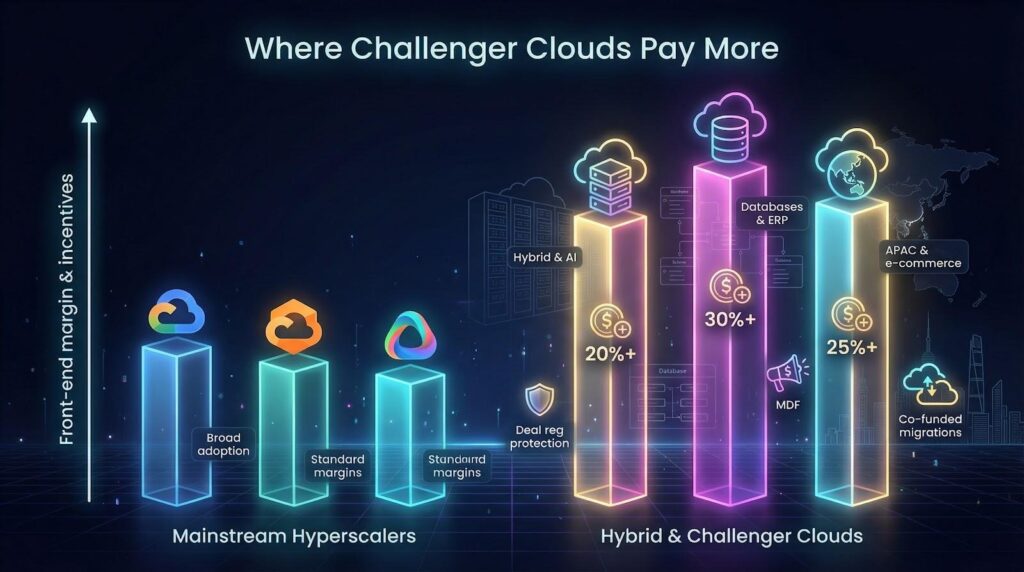
Across the next three sections, we review programs designed for hybrid or niche plays, starting with IBM’s renewed channel push.
IBM Partner Plus
IBM dabbled with the channel for years, but Partner Plus marks a full-throttle return. Three tiers—Silver, Gold, and Platinum—set the rewards, yet the ladder stays clear: meet the revenue target, earn product badges, and promotion follows automatically.
The real draw is cash. New-client rebates reach 20 percent on IBM Cloud or SaaS deals, and influence fees are paid even when IBM bills the customer directly. Add strong deal-registration protection and a six-figure project can deliver margins the hyperscalers reserve for their top partners.
Support is equally bold. IBM has doubled partner-facing technical staff, rolled out free Red Hat OpenShift training, and offers sandbox accounts so architects can demo hybrid deployments without burning billable hours. Partners focused on AI or mainframe workloads also tap IBM engineers who co-design solutions and often join customer calls under your brand.
Drawbacks echo IBM history. Paperwork can feel old-school, and dabblers stay stuck at Silver where incentives fade quickly. Commit to certifications and regulated-industry targets, though, and Partner Plus turns IBM’s hybrid story into a profitable niche your competitors may ignore.
Oracle PartnerNetwork
Oracle challenges the hyperscalers in public cloud yet dominates enterprise databases, and that legacy funds some of the richest partner incentives on the market. Join the Cloud Sell track, register an OCI deal, and Oracle often approves discounts above 20 percent, roughly triple the front-end margin typical of AWS or Azure. Secure a three-year commitment and tiered rebates stack on top, pushing effective profit beyond 30 percent on many workloads.
Oracle adds co-funded migrations. If you need to move a customer’s on-prem ERP to OCI, submit a business case and Oracle may provide prepaid credits that offset your service hours. Finish under budget, and the leftover credit drops to your bottom line.
Certification requirements appear steep. Credentials such as OCI Architect Associate and Cloud Operations Professional are expected, yet Oracle provides free training and exam vouchers. Certified partners gain priority co-sell routing; Oracle account executives bring you into deals where clients want to cut data-center costs but fear refactoring key databases.
Risks revolve around demand and talent supply. OCI still trails the hyperscalers in mindshare, so your sales team must focus on concrete economic wins like lower licensing costs, stronger price-performance for Oracle Database, or multicloud interconnects with Azure. You will also need architects fluent in Oracle tooling, a rarer skill set than general AWS expertise.
Treat those hurdles as a moat. Build a lean bench of certified pros, target customers already paying seven-figure Oracle support bills, and you will face limited competition while collecting margins the big clouds no longer provide.
Alibaba Cloud Partner Network
Alibaba Cloud dominates in China and now pushes across Asia, the Middle East, and parts of Europe. To attract overseas partners, it offers headline margins that recall early-cloud days; discounts can exceed 30 percent when you commit to monthly spend targets.
The program ladder is simple: Standard, Selected, Premium, and Elite. Move up by certifying engineers—Alibaba ACA and ACP exams are free online—and by hitting revenue thresholds. Reach Premium and Alibaba assigns a regional partner manager plus co-marketing funds for roadshows or virtual summits. Elite partners gain project-based rebates, priority support queues, and joint solution blueprints you can white-label.
Alibaba’s technical catalog mirrors AWS with compute, object storage, database, and AI services, but its advantage is low latency into mainland China and compliance coverage that foreign hyperscalers cannot match. If your clients manufacture in Shenzhen or sell through Tmall, hosting workloads on Alibaba Cloud cuts connection delays and meets data-locality rules in one move.
Risks center on geopolitics and demand. U.S. federal contractors will not use a Chinese platform, and public perception can change with the next headline. Partners who thrive pick their spots: APAC subsidiaries, e-commerce rollouts, or multinational firms expanding customer experience in China. In those lanes, high margins plus Alibaba-funded migration credits create quick ROI and limited competition.
Bottom line: Alibaba Cloud is not for every VAR, but if your territory or customer base leans toward Asia, the Partner Network delivers substantial discounts, strong MDF, and a first-mover edge that western hyperscalers struggle to match.
Quick comparison table
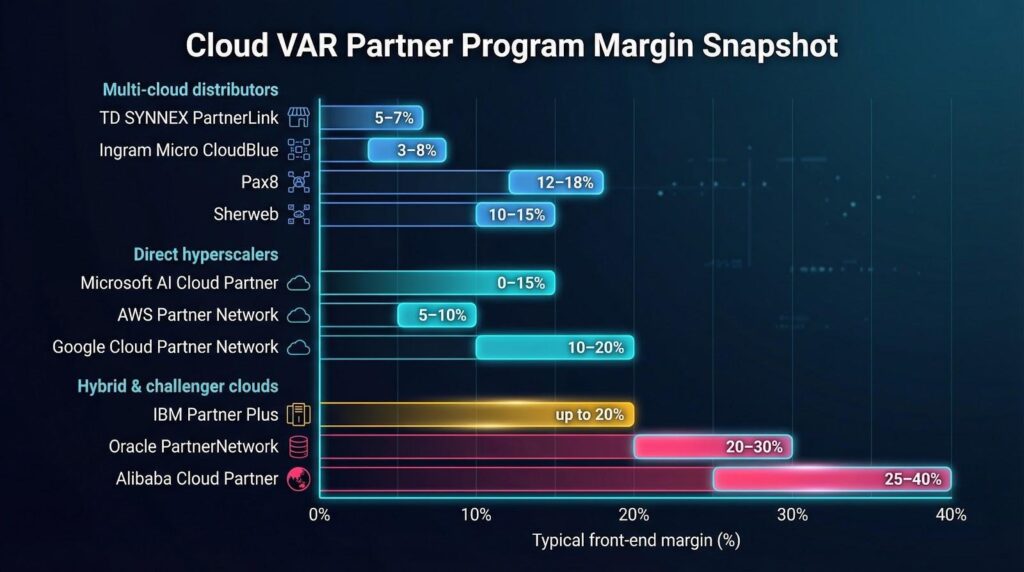
Decisions often come down to a clear side-by-side view: Where is the money, how hard is the climb, and who answers the phone when issues arise? The table below distills those answers. Use it as a reality filter before you commit certifications, staffing, or marketing dollars.
| Program | Core focus | Typical front-end margin | Stand-out incentive | Support reputation |
| TD SYNNEX PartnerLink | Multi-cloud distribution | 5–7 percent | 5-Star CRN status signals extra vendor-funded rebates | Solid once revenue grows |
| Ingram Micro CloudBlue | Multi-cloud distribution | 3–8 percent | AI-driven Xvantage upsell suggestions | Varies by tier; strong for large VARs |
| Pax8 | Cloud for MSPs | 12–18 percent on Microsoft 365 | Marketplace plus white-glove support praised by MSP community | Deal-reg rebates even when IBM bills the client |
| Sherweb | Microsoft-centric distribution | 10–15 percent | Free migrations and Azure growth credits | Fast, hands-on engineers |
| Microsoft AI Cloud Partner | Hyperscaler | 0–15 percent plus rebates | Partner Earned Credit and usage bonuses | Improves sharply at Solutions Partner level |
| AWS Partner Network | Hyperscaler | 5–10 percent | New Customer and Partner Growth rebates simplify earnings | Premier partners get dedicated PDMs |
| Google Cloud Partner Network | Hyperscaler | 10–20 percent (Workspace) | Outcome-based success bonuses; auto-logged evidence | AI-enhanced portal cuts admin time |
| IBM Partner Plus | Hybrid & AI | Up to 20 percent plus influence fees | Deal-reg rebates even when IBM bills client | Direct architect access at Gold+ |
| Oracle PartnerNetwork | OCI & Apps | 20–30 percent | Pre-paid migration credits and tiered rebates | Tight alignment with Oracle SEs |
| Alibaba Cloud Partner | APAC focus | 25–40 percent | MDF for new-region expansion | Regional partner managers |
Let the margin column serve as a starting point, then weigh support and incentives carefully. A smaller discount paired with responsive engineers and stackable rebates often beats a headline margin that leaves you on your own.
Frequently asked questions
Do I need to pick just one program?
No. Most successful VARs work with two or three. A distributor relationship covers day-to-day SaaS renewals, while a direct hyperscaler badge wins larger projects that demand deeper expertise.
Is the direct path always more profitable?
Not at first. Until you meet the vendor’s performance targets, distributor rebates plus lower overhead often beat thin direct margins. Run the numbers on certification costs, billing tools, and support headcount before you switch.
How long does it take to break even on certifications?
Partners we interviewed recover exam fees and study time in about six months once rebates start flowing. Speed improves if you bundle training into paid customer workshops—Microsoft and AWS frequently fund those engagements, turning learning into revenue.
What’s the biggest mistake new partners make?
Skipping the deal-registration steps. Log opportunities early, update status often, and secure approval notices. Miss a requirement and the extra eight or ten percentage points disappear, taking your projected profit with them.
Can I switch distributors without disrupting customers?
Yes, but treat the change like any migration project. Map license IDs, align billing cycles, and alert clients so invoices do not land from two places in the same month. Most portals automate tenant moves, yet people and processes still decide whether the transition feels smooth.
Wrapping it up
Cloud margins are not dead; they are simply hidden behind the right partner contracts. Start with a distributor for breadth and back-office muscle, move to direct hyperscaler programs when volume and skills justify it, and add a challenger cloud where incentives outpace competition.
Set aside an hour this week to map certifications, register one new deal, or book a vendor practice-builder workshop. Momentum compounds, rebates stack, and soon you will wonder how you ever sold on a straight license spread.
We will keep tracking program tweaks and fresh incentives throughout the year. Subscribe to the NextTechInsight newsletter, and we will send bite-size updates plus an occasional partner tip from the trenches every other Tuesday. Until then, pick your lane, claim your rebates, and turn cloud resale into the profit engine it should be.
Don’t miss out on any news—keep in touch for real-time information, visit Next Tech Insight!